This article and associated images are based on a poster originally authored by Christopher Becker, T. Ishigami, S. Adachi, S. Funayama, K. Kotagiri and N. Ichimura and presented at ELRIG Drug Discovery 2025 in affiliation with Aurora Microplates and Zeon Corporation.
This poster is being hosted on this website in its raw form, without modifications. It has not undergone peer review but has been reviewed to meet AZoNetwork's editorial quality standards. The information contained is for informational purposes only and should not be considered validated by independent peer assessment.

Overview
We have developed ready-to-use COP* microplates coated with Zeon's original coating materials for adherent cell culture and cell-based assays. Our plates are applicable to various type of cells including cell lines, primary cells and neural cells. The features of our plates are good bottom flatness, low autofluorescence, and excellent storage stability at room temperature for 12 months.
*Cyclo Olefin Polymer (COP) is a thermoplastic resin developed by Zeon.
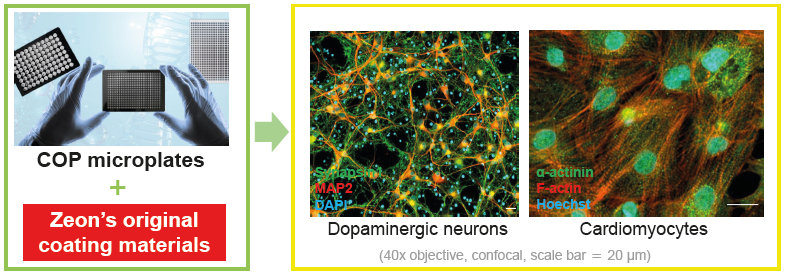
Image Credit: Image courtesy of Christopher Becker et al., in partnership with ELRIG (UK) Ltd.
Clear cell images are obtained at high magnification.
Features
Bottom flatness
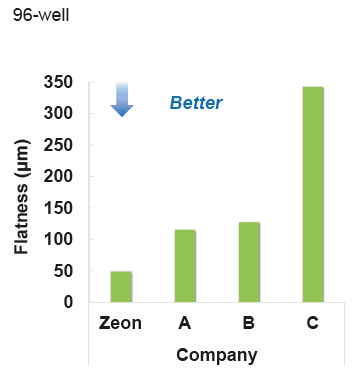
Image Credit: Image courtesy of Christopher Becker et al., in partnership with ELRIG (UK) Ltd.
Autofluorescence
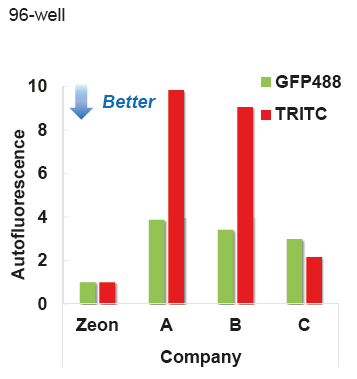
Image Credit: Image courtesy of Christopher Becker et al., in partnership with ELRIG (UK) Ltd.
Lot-to-lot variation
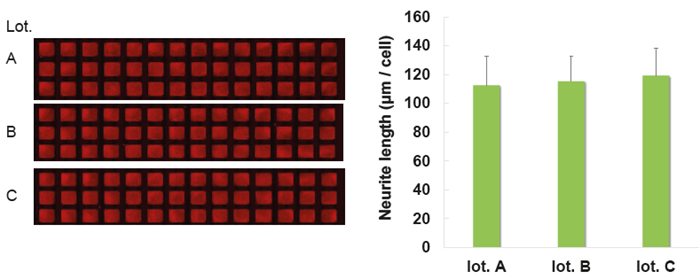
Image Credit: Image courtesy of Christopher Becker et al., in partnership with ELRIG (UK) Ltd.
Conditions
Cell: iCell® GlutaNeurons (FujiFilm Cellular Dynamics)
Cell density: 16,000 cells / well
Culture period: 14 days
Plates: COP 384-well microplate with Zeon's original coating materials
Immunostaining: MAP2 (red)
No effect for neuron culture was observed among lots.
Storage performance
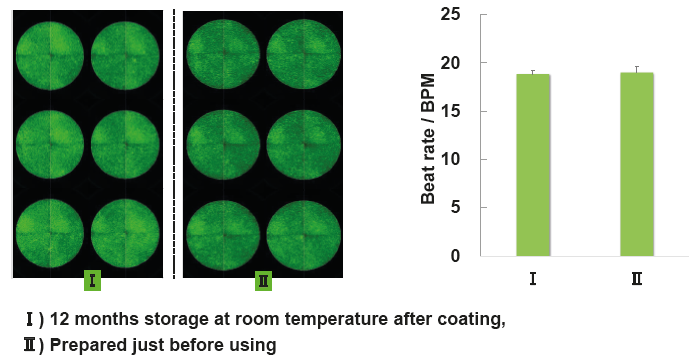
Image Credit: Image courtesy of Christopher Becker et al., in partnership with ELRIG (UK) Ltd.
Conditions
Cell: iCell® Cardiomyocytes2 (FujiFilm Cellular Dynamics)
Cell density: 75,000 cells / well
Culture period: 3 days
Plates: COP 96-well microplate with Zeon's original coating materials
Cell Staining: Cal-520 AM (green)
Our plates can be stored at r.t. for 12 months after coating.
Suitable applications
Source: ELRIG (UK) Ltd.
| Cell type |
Cells |
Application examples |
| Cell lines |
U2-OS, A549, MCF-7, HeLa, PANC-1, C2C12,
HEK293, etc. |
Apoptosis, Autophagy, DNA damage, Lipid droplet size and number, Cell differentiation, etc. |
| Primary |
Mesenchymal stem cell |
Adipogenic differentiation
Osteogenic differentiation |
| Human iPSC-derived cells |
Neural cells (Dopa, Motor, GABA, Gluta) |
Neurite outgrowth |
| Cardiomyocytes |
Cardiotoxicity assessment |
Comparison with existing precoated microplates
Neural cell attachment
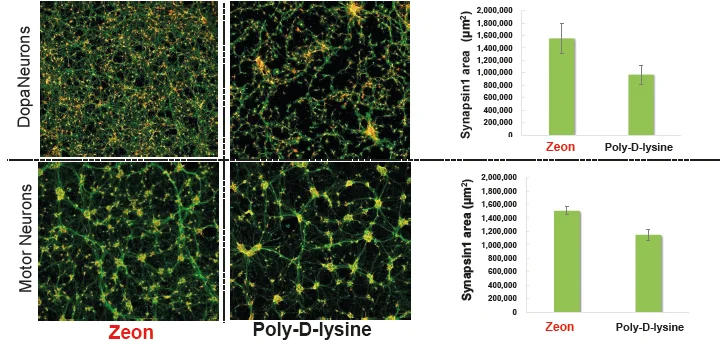
Image Credit: Image courtesy of Christopher Becker et al., in partnership with ELRIG (UK) Ltd.
- Cell:
iCell® DopaNeurons (FujiFilm Cellular Dynamics), Cell density: 64,000 cells / well, n12
iCell® Motor Neurons (FujiFilm Cellular Dynamics), Cell density: 32,000 cells / well, n18
- Culture period: 14 days
- Immunostaining: Synapsin1 (green), MAP2 (red), DAPI (blue)
- Plates: COP 96-well microplate precoated with Zeon's original coating materials
Existing 96-well microplate precoated with Poly-D-lysine
- Images: CellVoyager CQ1 (Yokogawa), 10x objective, scale bar = 100 μm
Adipogenic differentiation
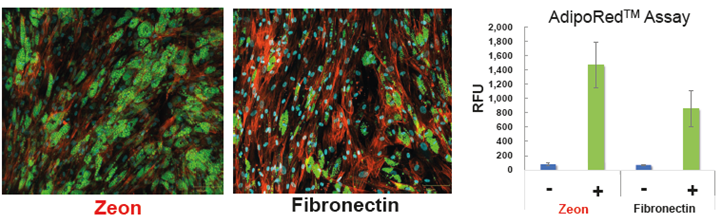
Image Credit: Image courtesy of Christopher Becker et al., in partnership with ELRIG (UK) Ltd.
- Cell: Human Mesenchymal Stem Cells from Adipose Tissue (PromoCell)
- Medium: Mesenchymal Stem Cell Adipogenic Differentiation Medium 2 (PromoCell)
- Cell density: 3,500 cells / well
- Differentiation culture period: 14 days
- Cell staining: Lipid droplets (BODIPY493 / 503, green), F-actin (red), Hoechst (blue)
- Plate: COP 96-well microplate precoated with Zeon's original coating materials
Existing 96-well microplate precoated with Fibronectin
- Images: CellVoyager CQ1 (Yokogawa), 20x objective, scale bar = 100 μm
- Assay: AdipoRedTM Assay Reagent (LONZA)
(-) Undifferentiation, n6, (+) Adipogenic differentiation, n16
Assay examples
Neurite outgrowth
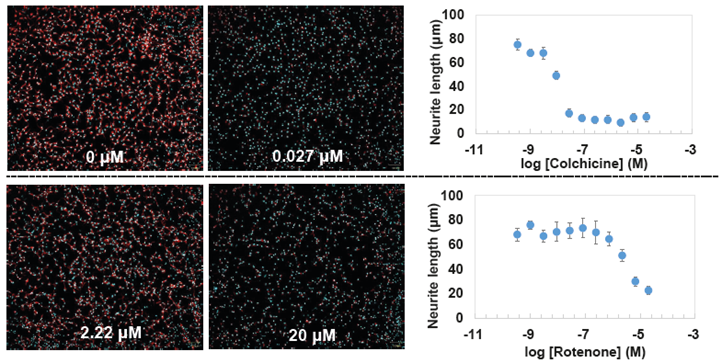
Image Credit: Image courtesy of Christopher Becker et al., in partnership with ELRIG (UK) Ltd.
iCell® GABANeurons (FujiFilm Cellular Dynamics) were seeded into the COP 384-well precoated with Zeon's original coating materials at 10,000 cells / well. After 48 hours incubation, colchicine and rotenone were transferred for a concentration of 20 μM~0.34 nM, n7 in each well. Plates were then incubated at 37 °C and 5 % CO2 for 48 hours. Cells were then fixed, stained. The images of MAP2 (red), DAPI (blue) were acquired using Yokogawa CellVoyager CQ1 (10x objective, confocal, scale bar = 100 μm). Neurite length were quantified with MAP2 using image analysis software (CellPathfinder, YOKOGAWA).
Summary
- We have developed COP microplates coated with Zeon's original coating materials.
- Our plates have excellent bottom flatness and storage performance at room temperature.
- Cells cultured on our plates showed better performance compared to existing precoated microplates.
- Our plates are suitable for cell-based assays that use various cells.
About Aurora Microplates
Since the late 1990s, Aurora Microplates has been a pioneer in microplate technology. The company’s journey began with the development of the groundbreaking 3456-well plate, designed to support 1 µL reaction volumes, and it has continued to lead the industry through ongoing innovation. By leveraging high-performance materials and advanced manufacturing methods, Aurora Microplates produces plates that are exceptionally clean, flat, and free from static interference.
About ELRIG (UK) Ltd.
The European Laboratory Research & Innovation Group (ELRIG) is a leading European not-for-profit organization that exists to provide outstanding scientific content to the life science community. The foundation of the organization is based on the use and application of automation, robotics and instrumentation in life science laboratories, but over time, we have evolved to respond to the needs of biopharma by developing scientific programmes that focus on cutting-edge research areas that have the potential to revolutionize drug discovery.
Comprised of a global community of over 12,000 life science professionals, participating in our events, whether it be at one of our scientific conferences or one of our networking meetings, will enable any of our community to exchange information, within disciplines and across academic and biopharmaceutical organizations, on an open access basis, as all our events are free to attend!
Our values
Our values are to always ensure the highest quality of content, that content will be made readily accessible to all, and that we will always be an inclusive organization, serving a diverse scientific network. In addition, ELRIG will always be a volunteer-led organization, run by and for the life sciences community, on a not-for-profit basis.
Our purpose
ELRIG is a company whose purpose is to bring the life science and drug discovery communities together to learn, share, connect, innovate and collaborate, on an open access basis. We achieve this through the provision of world-class conferences, networking events, webinars, and digital content.
Sponsored Content Policy: News-Medical.net publishes articles and related content that may be derived from sources where we have existing commercial relationships, provided such content adds value to the core editorial ethos of News-Medical.Net which is to educate and inform site visitors interested in medical research, science, medical devices and treatments.
Last Updated: Jan 6, 2026